1 is better than 20.
2 is better than 20.
3 is better than 20.
4 is better than 20.
5 is better than 20.
6 is better than 20.
7 is better than 20.
8 is better than 20.
9 is better than 20.
10 is better than 20.
11 is better than 20.
12 is better than 20.
13 is better than 20.
14 is better than 20.
15 is better than 20.
16 is better than 20.
17 is better than 20.
18 is better than 20.
19 is better than 20.
...
20 is better than 21.
Wednesday, June 30, 2010

Monday, March 8, 2010
The Synthesis of Woman & Demon
Seemingly, in Christianity, Angels cannot exist without the presence of Demons, just as God cannot exist without the presence of Satan. The pages of the Christian Bible are littered with appearances by monstrous figures, ranging from the insectoid Beelzebub, one of the seven princes of hell , to the multi-headed serpentine sea monster Leviathan . One of the most infamous demons featured in the Christian Canon is Lilith, a monstrous female associated with storms, illness, and death . While only mentioned once Biblically, Lilith is a figure prominently displayed among many cultural mythologies, dating back to ancient Sumerian tradition. While historically Eve is credited as the first woman created by God, there may be evidence in the writ that suggests that there was another before her . The Alphabet of Ben Sira, a satirical medieval text, says that God created Lilith from the earth, as He did with Adam, before the creation of Eve. When Lilith refused to become subservient to Adam, as she believed them to be equals, cut from the same cloth, God sent three angels to retrieve her and He created Eve from Adam’s rib . While both stories have, academically, receded into mere folklore, the exploration of the two females in Christianity prompts an interesting dialogue of the correlation between demons and the female sex.
Writer Marie-Hélene Huet draws from Aristotelian theory to suggest “The monster and the woman…find themselves on the same side, the side of dissimilarity .” Just as, she says, demons are engendered due to the power of a mother’s imagination during pregnancy, usurping the place of the father as progenitor , Eve as well is deformed when she is birthed from Adam’s body. Namely, she is dissimilar from man. She is not, however, dubbed a “demon” as Lilith was, in spite of the fact that Lilith was not the distorted offspring of a human.
Perhaps because of this conflation, women in Abrahamic religions are disvalued and their importance underplayed. In Judeo-Christian tradition, some important women such as Yael, killer of Sisera , and Delilah, the temptress and lover of Samson , are noted, but they are seen in a negative light. In Muslim tradition, women are severely undermined, with only one appearing in the Koran: the Virgin Mary . Mary is, without doubt, the most important woman in Abrahamic tradition, and the one viewed most positive among followers, albeit because she birthed Jesus, and as a character is strengthened from her similarities to the Lord.
The Hours of Catherine of Cleves, an illuminated manuscript lavishly decorated with scenes from Christian history, displays the intrinsic prominence of demonic imagery in the religion, and the correlations it draws between demons and women. In the Office of the Blessed Virgin Mary, demons encroach on the territories of the celebration of the Virgin’s story, disrupting the life of a woman with misogynistic undertones. In “Joachim and Anne Meeting at the Golden Gate,” depicting the discovery of Anne’s pregnancy with Mary, the marginalia are strife with demons: a blue dragon with a golden orb in its mouth, and a green goblin playing two pipes. In “God Dispatching the Archangel Gabriel,” a creature resembling an amalgamation of eagle, monkey and reptile settles itself onto the bottom of the page. And in the plate illustrating the Annunciation (Fig. 1), above the angel Gabriel and the Virgin Mary is the head of an orange demon in the archway, grimacing, holding two golden orbs in its claws. The event, a popular subject of Christian painting and an important story in the Bible, is disturbed by the presence of this figure.
 Fig. 1 Master of Catherine of Cleves, Annunciation (Detail) from the Hours of Catherine of Cleves, ca. 1440. 7 1/2 x 5 1/8 inches. Morgan Library and Museum, New York City.
Further into the Hours, in the Office of the Dead, the representation of Purgatory shows enfeebled bodies with the stout anatomy and fatty curves typically associated with children being devoured by flames in a leonine demon’s mouth. This purging of sin is a necessary step before entering the Kingdom of Heaven, and the chthonic imagery used to depict this realm clearly creates a comparison to Hell.
As in the plate depicting Purgatory, Hell is similarly rendered as a demonic mouth devouring souls (Fig. 2). However, in this image, the mouth is much grander, and more sinister, and a legion of demons is seen torturing the souls on their journey into the underworld. The ghoulish servants of Satan drive a black chariot, packed with humans, into the fiery maw. In both plates, the sensuous, undulating contours and sumptuous colors of the mouths of the beasts are decidedly vulvar in their execution. This picture of Hell once again links woman and demon in the Hours of Catherine of Cleves.
 Fig. 2 Master of Catherine of Cleves, Mouth of Hell (Detail) from the Hours of Catherine of Cleves, ca. 1440. 7 1/2 x 5 1/8 inches. Morgan Library and Museum, New York City.
The gruesome and demonic imagery present in the Bible as well as prayer books such as the Hours of Catherine of Cleves reinforces the idea that humans are subject to the will of higher forces, particularly women. Huet continues in her uncovering of the monstrous imagination by examining the etymology of the word “monster,” deciding it stems from the Latin monstrare meaning “to show, to display.” She concedes, “this tradition confirmed the idea that monsters were signs sent by God, messages showing his will or his wrath… ” Demonic imagery acts as a reminder to faithful Christians of the dangers of sin and the dissidence of God’s word. This idea stems from the story of Original Sin, in which Eve plights humanity for her disobedience to God’s strictures, cementing the connection of the woman and the demon.
People whose ideas I stole:
1. Mark 3:22
2. Isaiah 27:1
3. Isaiah 34:14
4. Genesis 1:27
5. “The Story of Lilith,” JewishChristianLit.com, http://jewishchristianlit.com//Topics/Lilith/alphabet.html
6. Marie-Hélene Huet, Monstrous Imagination (Harvard University Press, 1993), 85.
7. Ibid.
8. Judges 5:23-27
9. Judges 16
10. “Qur'anic verses - The Birth of Mary,” Koran.Topcities.com, http://koran.topcities.com/Mary(3,35-37).htm
11. Marie-Hélene Huet, Monstrous Imagination (Harvard University Press, 1993), 87.
Writer Marie-Hélene Huet draws from Aristotelian theory to suggest “The monster and the woman…find themselves on the same side, the side of dissimilarity .” Just as, she says, demons are engendered due to the power of a mother’s imagination during pregnancy, usurping the place of the father as progenitor , Eve as well is deformed when she is birthed from Adam’s body. Namely, she is dissimilar from man. She is not, however, dubbed a “demon” as Lilith was, in spite of the fact that Lilith was not the distorted offspring of a human.
Perhaps because of this conflation, women in Abrahamic religions are disvalued and their importance underplayed. In Judeo-Christian tradition, some important women such as Yael, killer of Sisera , and Delilah, the temptress and lover of Samson , are noted, but they are seen in a negative light. In Muslim tradition, women are severely undermined, with only one appearing in the Koran: the Virgin Mary . Mary is, without doubt, the most important woman in Abrahamic tradition, and the one viewed most positive among followers, albeit because she birthed Jesus, and as a character is strengthened from her similarities to the Lord.
The Hours of Catherine of Cleves, an illuminated manuscript lavishly decorated with scenes from Christian history, displays the intrinsic prominence of demonic imagery in the religion, and the correlations it draws between demons and women. In the Office of the Blessed Virgin Mary, demons encroach on the territories of the celebration of the Virgin’s story, disrupting the life of a woman with misogynistic undertones. In “Joachim and Anne Meeting at the Golden Gate,” depicting the discovery of Anne’s pregnancy with Mary, the marginalia are strife with demons: a blue dragon with a golden orb in its mouth, and a green goblin playing two pipes. In “God Dispatching the Archangel Gabriel,” a creature resembling an amalgamation of eagle, monkey and reptile settles itself onto the bottom of the page. And in the plate illustrating the Annunciation (Fig. 1), above the angel Gabriel and the Virgin Mary is the head of an orange demon in the archway, grimacing, holding two golden orbs in its claws. The event, a popular subject of Christian painting and an important story in the Bible, is disturbed by the presence of this figure.
 Fig. 1 Master of Catherine of Cleves, Annunciation (Detail) from the Hours of Catherine of Cleves, ca. 1440. 7 1/2 x 5 1/8 inches. Morgan Library and Museum, New York City.
Further into the Hours, in the Office of the Dead, the representation of Purgatory shows enfeebled bodies with the stout anatomy and fatty curves typically associated with children being devoured by flames in a leonine demon’s mouth. This purging of sin is a necessary step before entering the Kingdom of Heaven, and the chthonic imagery used to depict this realm clearly creates a comparison to Hell.
As in the plate depicting Purgatory, Hell is similarly rendered as a demonic mouth devouring souls (Fig. 2). However, in this image, the mouth is much grander, and more sinister, and a legion of demons is seen torturing the souls on their journey into the underworld. The ghoulish servants of Satan drive a black chariot, packed with humans, into the fiery maw. In both plates, the sensuous, undulating contours and sumptuous colors of the mouths of the beasts are decidedly vulvar in their execution. This picture of Hell once again links woman and demon in the Hours of Catherine of Cleves.
 Fig. 2 Master of Catherine of Cleves, Mouth of Hell (Detail) from the Hours of Catherine of Cleves, ca. 1440. 7 1/2 x 5 1/8 inches. Morgan Library and Museum, New York City.
The gruesome and demonic imagery present in the Bible as well as prayer books such as the Hours of Catherine of Cleves reinforces the idea that humans are subject to the will of higher forces, particularly women. Huet continues in her uncovering of the monstrous imagination by examining the etymology of the word “monster,” deciding it stems from the Latin monstrare meaning “to show, to display.” She concedes, “this tradition confirmed the idea that monsters were signs sent by God, messages showing his will or his wrath… ” Demonic imagery acts as a reminder to faithful Christians of the dangers of sin and the dissidence of God’s word. This idea stems from the story of Original Sin, in which Eve plights humanity for her disobedience to God’s strictures, cementing the connection of the woman and the demon.
People whose ideas I stole:
1. Mark 3:22
2. Isaiah 27:1
3. Isaiah 34:14
4. Genesis 1:27
5. “The Story of Lilith,” JewishChristianLit.com, http://jewishchristianlit.com//Topics/Lilith/alphabet.html
6. Marie-Hélene Huet, Monstrous Imagination (Harvard University Press, 1993), 85.
7. Ibid.
8. Judges 5:23-27
9. Judges 16
10. “Qur'anic verses - The Birth of Mary,” Koran.Topcities.com, http://koran.topcities.com/Mary(3,35-37).htm
11. Marie-Hélene Huet, Monstrous Imagination (Harvard University Press, 1993), 87.
Things I Miss
1. Mad Men
2. Being able to smoke without freezing to death
3. Wandering the streets of New York
4. No responsibility
5. Time to be by myself
I love snow and death and coats and boots, but now I'm over it. I want it to be warm outside.
2. Being able to smoke without freezing to death
3. Wandering the streets of New York
4. No responsibility
5. Time to be by myself
I love snow and death and coats and boots, but now I'm over it. I want it to be warm outside.
Thursday, March 4, 2010

Wednesday, March 3, 2010
Monday, March 1, 2010
Urban Decay
It's been ages. You thought I had abandoned you, didn't you? I did.
But I need an escape again, so we're back to our codependent relationship of me giving you content and you giving me approval. This time, it is to share the expanded version of the post I used to start the blog I was cheating on you with. Enjoy.
URBAN DECAY
I woke up at noon that Sunday morning, in my hotel room, slightly hung-over and craving nicotine. There wasn’t anything particularly out-of-the-ordinary about this situation, except that I was in Massachusetts, not New York. It took me a second to realize this as I coughed up the phlegm that had comfortably settled itself in the back of my throat. I was there on business. Or, at least, that’s what I would say to sound important and pretentious. I was attending the National Conference on Peer Tutoring in Writing with my boss, Brian, and some of my fellow tutors. I had worked as a peer writing consultant at FIT for about a year by that point, and I was incredibly happy with both my position and work environment. This trip was like the cherry in a Rob Roy. I had spent the weekend at Mount Holyoke College, one of the seven sisters, hearing presentations on the art of tutoring and, to an extent, the power of linguistics and literacy. I was enjoying myself.
I grabbed for my coat, careful not to disturb my roommate, and headed outside for a smoke. Thankfully we were able to sleep in that day, as on previous days we had to wake up at seven to attend the numerous presentations. Because of this, I went out for dinner with three other tutors (there were nine of us at the conference, in all) at an Armenian restaurant where I had delicious hummus and perhaps a tad too much to drink. I didn’t find it unprofessional, though; I was still twenty, after all.
When I walked outside into the sharp chill of the autumn wind, I discovered that I had only one cigarette left. Remembering the location of a nearby CVS (only a block and a half away) I went to replenish my stock before lighting it. When I arrived, though, I nearly smashed my face into the glass doors. Closed. I glanced at my phone; it was 12:30 PM. The sign said it opened at noon on Sundays.
This unusual setback cemented my feeling that Massachusetts was a strange, unholy land. I was finally made aware that I had unexpectedly entered a world with deer crossing signs, pristine streets free of used condoms and broken liquor bottles, and a town populated by mainly white, middle-aged heterosexuals. I tried to ignore this, since I was genuinely enjoying myself at the conference, but it was hard for me to extract myself from this environment now. Despite the fun I was having at Mount Holyoke, South Hadley was not a town I wanted to be in for much longer. Especially since I had no cigarettes left.
I figured I’d stay outside the CVS, half-hoping the owner or an employee would show up to open it, half-wanting to relish what may have been the last amounts of nicotine to enter my system that day. As I stood, brooding, a small white car pulled up at the curb in front of me. A stout woman came out, clad in a bright coral sweatshirt, light-wash jeans, and crocs. She came towards me. Frightened as I was by the sight of her, I refused to abandon my post.
“Good Morning!” She said with an excruciatingly perky cadence. I glared at her and took a drag as she walked to the door. When I realized she wasn’t opening it, I felt defeated once again.
“It’s closed.” I said, mistakenly eliciting a response from her.
“Oh, no…” She rummaged in her purse for something. “You know, this isn’t unusual; the owner usually goes out for breakfast after church with his family.” I could find about five things wrong with this sentence, “church” and “family” being at the top of my list. The proprietor of a tobacco dispensary shouldn’t spend his Sundays eating pancakes; he should be providing drugs to customers. She extracted two quarters from her coin purse (yes, she had an actual coin purse) and headed to the payphone beside me.
“My husband and I went to 9 o’clock mass this morning, and his sister is coming over to our house this afternoon with her husband and her three precious little girls. I’m making potato salad and roast beef sandwiches, a nice meal, but when I opened the fridge I saw we were out of tonic!” She laughed and dialed. It wasn’t until later that I found out that by “tonic” she meant soda, not a mixer containing quinine. I nodded, and looked down.
“What are you here for?”
“Cigarettes.” I said. “I heard they were cheap in Massachusetts.”
“Where’re you from?” She held the receiver to her ear.
“New York.” I tried to be as abrupt in my answers as possible. What on Earth had I done to this woman to make her want to talk to me?
“Is that right?” She smiled, and continued talking, holding the grimy receiver up to her chubby ear. I had absolutely no idea why her husband hadn’t answered the phone already. It felt like she had been chewing my ear off for a half hour. “How do you like it?”
“It’s fabulous.”
“I was in New York City this past summer. We took the kids to see The Lion King, took the train down for the day. Ah, shoot…” She hung up the phone. “I guess he’s watching football or something. Do those games start this early in the day?”
“I have no idea.” I wasn’t being totally dismissive. I really didn’t, and still don’t.
“Well, I guess I should go to Big Y and buy some stuff for later. It was nice talking to you!” She smiled again, waved, and walked to her car. I stubbed out my cigarette on the building.
The woman was insane.
I was incredibly anxious to go home. The conference was over, and I hadn’t been alone in three days. Not a moment was absent of another person, not even when I was deserted. I needed to be back in the city, back to civilization, back to solitary confinement.
After five hours of bumper-to-bumper traffic, we returned to New York that evening. Buildings replaced trees, smoke replaced air, vagrants replaced chipmunks. Nobody spoke to me unprovoked. I was happy to be back in the city. Initially.
But on my train ride home, alone, I sat ruminating on the nature of my weekend in the continental United States. The tone of South Hadley was something I’ve never really experienced; growing up in the suburbs, everyone was naturally nice, but not without artifice. There was always an unspoken air of competition that, as a child, I never picked up on, but soon discovered when I got older. A mother may invite you over for a play date with her daughter, but only in hopes that your mother would reciprocate. That way, she could have the freedom to spend her afternoon shopping, gossiping, popping pills and/or having an affair.
Manhattan was a little different. The artifice is still there, but not nearly as much; most New Yorkers have no problem being honest or even curt. I wouldn’t characterize New Yorkers as mean or uncaring, not necessarily, nor would I classify myself as such. I just feel that they exhibit a certain sense of detachment from the populous. Their lives are busy, and they know everyone else’s are. They live on an island, removed from the very land on which most other Americans live. They embrace the sort of relationship Woody Allen and Mia Farrow had.
When they were a couple, they lived in separate apartments on each side of Central Park, and when they spoke on the phone they would wave towels out of their windows to see one another. New Yorkers are solitary creatures, but they know that when they want intimacy from someone they can have it. And, more importantly, if they don’t want it, they don’t need it.
I always planned to live my life this way.
But now I felt slightly soured, and a little confused. I’ve always enjoyed being unsocial and cynical. I’ve always enjoyed being dwarfed by the shimmering steel and glass of skyscrapers. I’ve always enjoyed having everything I wanted at my fingertips. But was what that woman did at CVS really that horrible? She was just being nice. Maybe if I incorporated that obnoxious sunshine into my character, I wouldn’t be so fucking miserable all of the time.
The problem is, I’ve grown fond of misery.
Since I see the world in very definite terms (black & white, smart & dumb, gay & straight) I figured there were two paths I could take in my life from growing up in what some could describe as a Hegelian dialectic: being in the suburbs (synthesis) I could decide to progress either to the city (thesis) or the country (antithesis.) And since I had only experienced “the country” through films like Deliverance, I naturally chose the city. It seemed to be the obvious choice, especially since I had frequented Manhattan in my youth and viewed it as the Mecca of sophistication, culture, and intelligence. But my trip to Massachusetts has made me reexamine this choice. Just a little bit.
See, like William James and Abraham Lincoln, I am an “INTP” personality type according to the Myers-Briggs test. I like tests, especially those that define you as a person and reduce you to no more than four adjectives written on a piece of paper. I took it three times, each about six months apart, to be sure about my results. I was, ontologically, an introverted, intuitive, thinking, perceptive person. I don’t necessarily think that this was something I could cheat, a test that I could manipulate to get the results I wanted, and I’m pretty sated with knowing that this is my temperament. I live in my head, obsess over problems and try to find logical and rational solutions to them. I see everything in terms of how it can be improved and what it can become. I don’t normally like people, and I especially don’t understand those who succumb to their emotions on a regular basis.
Hearing this, it’s possibly easy to assume I would probably function better in a remote cabin in the woods, secluded from society, not a metropolis populated by some 8.4 million citizens. But, that still doesn’t feel quite right. I don’t think I ever want to leave New York.
Maybe I’m a masochist.
But I need an escape again, so we're back to our codependent relationship of me giving you content and you giving me approval. This time, it is to share the expanded version of the post I used to start the blog I was cheating on you with. Enjoy.
URBAN DECAY
I woke up at noon that Sunday morning, in my hotel room, slightly hung-over and craving nicotine. There wasn’t anything particularly out-of-the-ordinary about this situation, except that I was in Massachusetts, not New York. It took me a second to realize this as I coughed up the phlegm that had comfortably settled itself in the back of my throat. I was there on business. Or, at least, that’s what I would say to sound important and pretentious. I was attending the National Conference on Peer Tutoring in Writing with my boss, Brian, and some of my fellow tutors. I had worked as a peer writing consultant at FIT for about a year by that point, and I was incredibly happy with both my position and work environment. This trip was like the cherry in a Rob Roy. I had spent the weekend at Mount Holyoke College, one of the seven sisters, hearing presentations on the art of tutoring and, to an extent, the power of linguistics and literacy. I was enjoying myself.
I grabbed for my coat, careful not to disturb my roommate, and headed outside for a smoke. Thankfully we were able to sleep in that day, as on previous days we had to wake up at seven to attend the numerous presentations. Because of this, I went out for dinner with three other tutors (there were nine of us at the conference, in all) at an Armenian restaurant where I had delicious hummus and perhaps a tad too much to drink. I didn’t find it unprofessional, though; I was still twenty, after all.
When I walked outside into the sharp chill of the autumn wind, I discovered that I had only one cigarette left. Remembering the location of a nearby CVS (only a block and a half away) I went to replenish my stock before lighting it. When I arrived, though, I nearly smashed my face into the glass doors. Closed. I glanced at my phone; it was 12:30 PM. The sign said it opened at noon on Sundays.
This unusual setback cemented my feeling that Massachusetts was a strange, unholy land. I was finally made aware that I had unexpectedly entered a world with deer crossing signs, pristine streets free of used condoms and broken liquor bottles, and a town populated by mainly white, middle-aged heterosexuals. I tried to ignore this, since I was genuinely enjoying myself at the conference, but it was hard for me to extract myself from this environment now. Despite the fun I was having at Mount Holyoke, South Hadley was not a town I wanted to be in for much longer. Especially since I had no cigarettes left.
I figured I’d stay outside the CVS, half-hoping the owner or an employee would show up to open it, half-wanting to relish what may have been the last amounts of nicotine to enter my system that day. As I stood, brooding, a small white car pulled up at the curb in front of me. A stout woman came out, clad in a bright coral sweatshirt, light-wash jeans, and crocs. She came towards me. Frightened as I was by the sight of her, I refused to abandon my post.
“Good Morning!” She said with an excruciatingly perky cadence. I glared at her and took a drag as she walked to the door. When I realized she wasn’t opening it, I felt defeated once again.
“It’s closed.” I said, mistakenly eliciting a response from her.
“Oh, no…” She rummaged in her purse for something. “You know, this isn’t unusual; the owner usually goes out for breakfast after church with his family.” I could find about five things wrong with this sentence, “church” and “family” being at the top of my list. The proprietor of a tobacco dispensary shouldn’t spend his Sundays eating pancakes; he should be providing drugs to customers. She extracted two quarters from her coin purse (yes, she had an actual coin purse) and headed to the payphone beside me.
“My husband and I went to 9 o’clock mass this morning, and his sister is coming over to our house this afternoon with her husband and her three precious little girls. I’m making potato salad and roast beef sandwiches, a nice meal, but when I opened the fridge I saw we were out of tonic!” She laughed and dialed. It wasn’t until later that I found out that by “tonic” she meant soda, not a mixer containing quinine. I nodded, and looked down.
“What are you here for?”
“Cigarettes.” I said. “I heard they were cheap in Massachusetts.”
“Where’re you from?” She held the receiver to her ear.
“New York.” I tried to be as abrupt in my answers as possible. What on Earth had I done to this woman to make her want to talk to me?
“Is that right?” She smiled, and continued talking, holding the grimy receiver up to her chubby ear. I had absolutely no idea why her husband hadn’t answered the phone already. It felt like she had been chewing my ear off for a half hour. “How do you like it?”
“It’s fabulous.”
“I was in New York City this past summer. We took the kids to see The Lion King, took the train down for the day. Ah, shoot…” She hung up the phone. “I guess he’s watching football or something. Do those games start this early in the day?”
“I have no idea.” I wasn’t being totally dismissive. I really didn’t, and still don’t.
“Well, I guess I should go to Big Y and buy some stuff for later. It was nice talking to you!” She smiled again, waved, and walked to her car. I stubbed out my cigarette on the building.
The woman was insane.
I was incredibly anxious to go home. The conference was over, and I hadn’t been alone in three days. Not a moment was absent of another person, not even when I was deserted. I needed to be back in the city, back to civilization, back to solitary confinement.
After five hours of bumper-to-bumper traffic, we returned to New York that evening. Buildings replaced trees, smoke replaced air, vagrants replaced chipmunks. Nobody spoke to me unprovoked. I was happy to be back in the city. Initially.
But on my train ride home, alone, I sat ruminating on the nature of my weekend in the continental United States. The tone of South Hadley was something I’ve never really experienced; growing up in the suburbs, everyone was naturally nice, but not without artifice. There was always an unspoken air of competition that, as a child, I never picked up on, but soon discovered when I got older. A mother may invite you over for a play date with her daughter, but only in hopes that your mother would reciprocate. That way, she could have the freedom to spend her afternoon shopping, gossiping, popping pills and/or having an affair.
Manhattan was a little different. The artifice is still there, but not nearly as much; most New Yorkers have no problem being honest or even curt. I wouldn’t characterize New Yorkers as mean or uncaring, not necessarily, nor would I classify myself as such. I just feel that they exhibit a certain sense of detachment from the populous. Their lives are busy, and they know everyone else’s are. They live on an island, removed from the very land on which most other Americans live. They embrace the sort of relationship Woody Allen and Mia Farrow had.
When they were a couple, they lived in separate apartments on each side of Central Park, and when they spoke on the phone they would wave towels out of their windows to see one another. New Yorkers are solitary creatures, but they know that when they want intimacy from someone they can have it. And, more importantly, if they don’t want it, they don’t need it.
I always planned to live my life this way.
But now I felt slightly soured, and a little confused. I’ve always enjoyed being unsocial and cynical. I’ve always enjoyed being dwarfed by the shimmering steel and glass of skyscrapers. I’ve always enjoyed having everything I wanted at my fingertips. But was what that woman did at CVS really that horrible? She was just being nice. Maybe if I incorporated that obnoxious sunshine into my character, I wouldn’t be so fucking miserable all of the time.
The problem is, I’ve grown fond of misery.
Since I see the world in very definite terms (black & white, smart & dumb, gay & straight) I figured there were two paths I could take in my life from growing up in what some could describe as a Hegelian dialectic: being in the suburbs (synthesis) I could decide to progress either to the city (thesis) or the country (antithesis.) And since I had only experienced “the country” through films like Deliverance, I naturally chose the city. It seemed to be the obvious choice, especially since I had frequented Manhattan in my youth and viewed it as the Mecca of sophistication, culture, and intelligence. But my trip to Massachusetts has made me reexamine this choice. Just a little bit.
See, like William James and Abraham Lincoln, I am an “INTP” personality type according to the Myers-Briggs test. I like tests, especially those that define you as a person and reduce you to no more than four adjectives written on a piece of paper. I took it three times, each about six months apart, to be sure about my results. I was, ontologically, an introverted, intuitive, thinking, perceptive person. I don’t necessarily think that this was something I could cheat, a test that I could manipulate to get the results I wanted, and I’m pretty sated with knowing that this is my temperament. I live in my head, obsess over problems and try to find logical and rational solutions to them. I see everything in terms of how it can be improved and what it can become. I don’t normally like people, and I especially don’t understand those who succumb to their emotions on a regular basis.
Hearing this, it’s possibly easy to assume I would probably function better in a remote cabin in the woods, secluded from society, not a metropolis populated by some 8.4 million citizens. But, that still doesn’t feel quite right. I don’t think I ever want to leave New York.
Maybe I’m a masochist.
Tuesday, June 16, 2009
Wednesday, June 10, 2009
Abandon all Hope Ye who Enter here
 I've been thinking a lot lately about hope. It seems to me that it is always absent in my life, either due to my innate cynicism or the pressures of the outside world. It's hard to have hope when you're constantly in competition with yourself, and everyone else for that matter. It seems we forget about the goal and concentrate only on the means. There's a line that was cut out of The Good, the Bad and the Ugly that was subsequently used as an episode title for Weeds: "If you work for a living, why do you kill yourself working?" It's simple (and quirky) enough to describe my predicament. I wish I could just lay back, watch the world go by and do as I please for the rest of time, but it's never possible. Responsibilities set in with age, dictated by the society in which we live; we must work, we must make money, we must be independent by depending on others. It all seems so pedestrian.
And, in spite of this, I constantly feel as if I'm setting myself up for failure. Instead of pursuing some career that is reliable or stable I chose to go into intensely competitive fields that feed on rewarding the "best" and disregarding the "rest". Initially, I chose to participate in "art" because it was what made me happy. It makes enough sense: do what makes you happy and you'll be happy. Not true. Any personal gratification I acheived through expressing myself has been tainted. It's all about profit and showing someone up and proving to the rest of the world that you have something. Perhaps creativity should not be a business, but nevertheless it is. Why is success only attainable through money?
I feel hopeless. I wish I could just be.
Friday, June 5, 2009
The Red Menace.

Yesterday I bit the bullet I had been facing for so long and registered myself with the New York State Communist Party. Difficult as it was, when I returned home that evening I found a package containing a shirt I ordered almost a month ago: tomato red with the word "Communist" silk screened on the chest. Providence or Coincidence?
Now, apparently, I am a communist. Or, at least, as much as one can be in a free market society. But what does this mean? Most people I've told have reacted with horror as if I am going to be brought up before the House Un-American Activities Committee, but the whole ordeal was hardly as unnerving as I had originally planned for. Three individuals from the party have already contacted me, welcoming me and telling me they were there if I had any questions. In fact, I'm supposed to arrange a formal meeting with someone later this week. It all seems perfectly normal. I guess we'll see.
Thursday, June 4, 2009
Uncivil Disobedience
 THEATER REVIEW|'GOD OF CARNAGE'
“Children consume and fracture our lives. Children drag us towards disaster, it’s unavoidable.” Michael says in Yasmina Reza’s brilliant new comedy. “Brilliant” is a word I despise, repeated ad nauseum and usually applied to all the wrong things, but there is no other word to describe “God of Carnage”. It was unequivocally the best play I have seen all season, and, to be perfectly blunt, the first play since Kushner’s “Angels in America” that has restored my faith in the theatre. Acerbic, thought provoking, and hilarious, it is all that the theatre is meant to be, and comfortably capitulates to the New York sensibility Broadway should provide.
Originally a French play, produced numerous times in Europe (including one in London starring Janet McTeer and Ralph Fiennes), “Le Dieu de Carnage” as it is called, was translated by Christopher Hampton into English. It tells the story of two bourgeoisie couples who arrange to have a civil meeting after one of their children assaults the other with a stick on the playground. The slick set design offers a cold, modern space suspended in emotion. Bright red walls that stretch up into the sky are revealed when a large white curtain decorated with a child’s crayon-rendered family portrait rises. An oblique, stone wall is in the background. The stage is flanked by two perfect crystal vases filled with white tulips (from the Korean Deli up the street, direct from Holland, $40 for Fifty). Lead by an all-star cast (Marcia Gay Harden, James Gandolfini, Jeff Daniels and Hope Davis) the material is never allowed to rest. Discussions turn to arguments, arguments turn to violence, violence turns to despair all in one tense, Albeesque afternoon.
An obvious devolution occurs with each character (although perhaps not as much with Alan, who is a prick to begin with) and their carefully manicured facades crumble when confronted with the realities of existence. Ms. Harden and Mr. Gandolfini in particular deftly transform on stage as the play progresses. Matthew Warchus’s direction is absolutely splendid; the blocking is obviously very calculated and deliberate but appears effortless, and the special effects (namely projectile vomiting on the part of Ms. Davis, another nod to Albee) are well handled and natural.
As Ms. Reza’s words entertain, they simultaneously subvert societal mores, the role of parents, and the relationships we all have. Her play is fabulous. That’s all. Nothing more.
GOD OF CARNAGE
By Yasmina Reza; translated by Christopher Hampton; directed by Matthew Warchus; sets and costumes by Mark Thompson; lighting by Hugh Vanstone; music by Gary Yershon; sound by Simon Baker/Christopher Cronin; production stage manager, Jill Cordle; production manager, Aurora Productions; general manager, STP/David Turner. Presented by Robert Fox, David Pugh and Dafydd Rogers, Stuart Thompson, the Shubert Organization, Scott Rudin, Jon B. Platt and the Weinstein Company. At the Bernard Jacobs Theater, 242 West 45th Street, Manhattan; (212) 239-6200. Through July 19. Running time: 1 hour 30 minutes.
WITH: Jeff Daniels (Alan), Hope Davis (Annette), James Gandolfini (Michael) and Marcia Gay Harden (Veronica).
Tuesday, June 2, 2009
Day in the Life
Morning: Overslept exactly three minutes due to retiring at 2:30am after caring for nervous dog.
Commute: Late train. Arrive in New York at 9:15 for 9:10 class.
Breakfast: Coffee and cigarette.
Class: Art History; discover Courbet and his Realist Manifesto (read.)
Break: Cigarette.
Lunch: Free peanut granola bar from guy on 29th.
Recent purchases: Weeds Season 4 on DVD; Tony Kushner's "A Bright Room Called Day". Both great. Both overpriced.
What's to come: Bio in a medium-security classroom. Work in a medium-security Writing Studio. I hope no one comes in.
What still holds true: I enjoy New York. We'll see when that dissipates.
Commute: Late train. Arrive in New York at 9:15 for 9:10 class.
Breakfast: Coffee and cigarette.
Class: Art History; discover Courbet and his Realist Manifesto (read.)
Break: Cigarette.
Lunch: Free peanut granola bar from guy on 29th.
Recent purchases: Weeds Season 4 on DVD; Tony Kushner's "A Bright Room Called Day". Both great. Both overpriced.
What's to come: Bio in a medium-security classroom. Work in a medium-security Writing Studio. I hope no one comes in.
What still holds true: I enjoy New York. We'll see when that dissipates.
Saturday, May 23, 2009
Sister, Brother, Teacher, Mother.
Imagine having drinks with your teacher. Now, imagine having drinks with your mother. Now imagine the complete opposite of what you would expect.
It all started about a week ago. Finally finishing up with school, I was headed out for a celebratory lunch with the girls when our professor invited himself along. An odd twist on our plans, but, we went with it and had lunch at Bar 89 (and several other locations). Who knows, maybe it improved our grades. So, I did what any perfectly normal young man would do when going out with a man old enough to be his father: I drank. Three beers, two absinthe and a shot of tequila later I felt better than I had in a while. Alcohol cures all. And while no sex resulted from my inebriation, I realized something: here I was, plastered, hadn't paid for a thing, all in front of my teacher. It seemed wrong.
Flash forward to the next day of cocktails at the Algonquin. Too much drinking again, this time martinis, this time with my mother. She had begun to tell me about how she recently got in touch with an old college mate who now does the makeup for "All My Children". She relayed to me how they used to fawn after the same bisexual guy in school. My mother would even smoke to impress him (though she never inhaled). Again, aside from the nausea, dizziness and mediocre piece of theater we ended up seeing, I felt wrong.
Maybe it's just the onset of adulthood, realizing that everyone is more or less a rather complex person whose identity reaches far beyond your perception. But, nevertheless, it is alarming when the barriers break down, considering how much you thought you knew about a person, let alone your purported role models.
It all started about a week ago. Finally finishing up with school, I was headed out for a celebratory lunch with the girls when our professor invited himself along. An odd twist on our plans, but, we went with it and had lunch at Bar 89 (and several other locations). Who knows, maybe it improved our grades. So, I did what any perfectly normal young man would do when going out with a man old enough to be his father: I drank. Three beers, two absinthe and a shot of tequila later I felt better than I had in a while. Alcohol cures all. And while no sex resulted from my inebriation, I realized something: here I was, plastered, hadn't paid for a thing, all in front of my teacher. It seemed wrong.
Flash forward to the next day of cocktails at the Algonquin. Too much drinking again, this time martinis, this time with my mother. She had begun to tell me about how she recently got in touch with an old college mate who now does the makeup for "All My Children". She relayed to me how they used to fawn after the same bisexual guy in school. My mother would even smoke to impress him (though she never inhaled). Again, aside from the nausea, dizziness and mediocre piece of theater we ended up seeing, I felt wrong.
Maybe it's just the onset of adulthood, realizing that everyone is more or less a rather complex person whose identity reaches far beyond your perception. But, nevertheless, it is alarming when the barriers break down, considering how much you thought you knew about a person, let alone your purported role models.
Philological Philanthropy

Theater Review|'The Philanthropist'
I am at a loss for words on this one; maybe because the play was light, maybe because I was drunk and slept through the last scene of the first act. In any event, Christopher Hampton's play about a 70's philology professor who's naivete is mistaken for animosity was cute. Not incredibly moving, intriguing, and at some times very callow (Hampton was only 23 when he wrote it, after all), the play managed to illicit a few laughs and smiles. Matthew Broderick was convincing enough, although at times he resorted to being too dry, perhaps mistaking the emotion for the callus simplicity needed for the role.
Design-wise, the production was decent. The set was very, very tall (which seems to be a trademark of the American Airlines Theater) and minimal. It's saved, though by the illuminating letters across the top of walls, which aided in scene changes by spelling out one of the seven deadly sins (each character is supposed to represent one). The character Celia's costumes were very 60's London Mary Quant-esque, while Braham's multi-colored, bell bottom, three-piece suit was, while charming, a little more late 70's.
In any event, I have no more to say about this production (mainly because last night is a bit of a blur by now), but I will point you in the direction of the New York Times review. It's harsh, but points out what's wrong with this production.
THE PHILANTHROPIST
By Christopher Hampton; directed by David Grindley; sets by Tim Shortall; costumes by Tobin Ost; lighting by Rick Fisher; sound by Gregory Clarke; dialect coach, Gillian Lane-Plescia; associate artistic director, Scott Ellis. Presented by the Roundabout Theater Company, Todd Haimes, artistic director. At the American Airlines Theater, 227 West 42nd Street, Manhattan, (212) 719-1300. Through June 28. Running time: 2 hours 10 minutes.
WITH: Matthew Broderick (Philip), Jonathan Cake (Braham), Anna Madeley (Celia),Steven Weber (Donald), Tate Ellington (John), Jennifer Mudge (Araminta) and Samantha Soule (Elizabeth)
Tuesday, May 19, 2009
Do I?
Let me tell you a story: a girl of 27 living life humbly as an elementary school teacher meets a fantastic guy and gets engaged. In two months, they will be newlyweds. She will continue to work, she says, but hopes her husband will make enough money so that she can be a stay-at-home housewife. She seems happy enough, and has truly found a man who seamlessly fits into her family; he's cute, smart, and Italian. And no it's not me, just to avoid any misinterpretation of the story. At this point, it does seem as if they will live happily ever after.
Let me tell you another story: a girl of 29, newly hired as a professor at a New York college, soon to complete her dissertation and receive a PhD. She has already completed her Master's, and apparently has nowhere to go but up. Her students love her, she's an excellent teacher, and she has the potential to go on to bigger and better colleges, where one will no doubt grant her tenure. She seems happy enough, and has found, in my mind, a truly satisfying career. In addition to this fabulous success, she also has a domestic partner. No, she isn't a lesbian. Her boyfriend has lived with her so long that the government has ostensibly married them on their tax forms. When asked if she ever wanted to get married, she replied "Eh."
So what do these two stories tell us? One woman happily satisfied with her husband, not with her career, and another woman feeling the exact opposite. So here's the dreadful question we as a society must ask: Who's happier?
For a long time now, as most people know, the prospect of marriage and family has never appealed to me, and I have for the most part lived for myself. My ambitions are to buy a Classic Six on the Upper East Side, not to share it with someone. I don't mean to pump out another Carrie Bradshaw-esque post on this sorry little blog, but it comes across my mind as strange that I've never once wanted to meet someone, build a life with him and have children. Perhaps because of my orientation, or my disdain for some of my relatives, I have no impulse to propagate my gene pool. Or perhaps it's because I detest little children and would, if given the opportunity, reject rearing them properly and perform psychological experiments on them just out of sheer curiosity. Such as, oh, let's say showering one with gifts and praise and locking the other up in the basement feeding him cow hooves and old milk and comparing and contrasting the final outcome. Or naming my son "Wendy" and force him to wear girls' clothes to see if it has any effect on his gender identification or sexual orientation.
As it can be seen, Social Services would be up my ass if I were a parent. At least if I were a parent now, anyway. This doesn't really cover the eternal, lifelong relationship part of the equation that I do not enjoy anymore. Why don't I have the urge to shack up with a guy and share my deepest darkest secrets with him? My friends have boyfriends, my cousins have husbands, so what's wrong with me? Perhaps I should just give a relationship a try. And I mean a real relationship, not the two dates and a blowjob in a public restroom kind of relationship that I---have heard some people have. Maybe.
So what are we to believe? The woman who might not have the best personal life, despite all of the success she has otherwise, is not really happy? If I concentrate on my studies and just try to get degree after degree, what, I'm not worthy of anyone's reverence because I didn't just go to some bar, pick up some guy, and marry him? And what if, maybe, I will really feel fulfillment in my life if I'm in a relationship? What am I to do?
Anyway, with the prospect of New York legislature granting gay marriage rights to the masses, maybe I should just consider finding a sugar daddy to marry me, that way I can figure this stuff (re: my life) out while not breaking a sweat about my credit card debt or rent bills in exchange for the occasional handjob. That's the kind of relationship I can picture myself in. For the time being, anyway.
Friday, May 8, 2009
There's no Business like Show Business.
The official end to the awards season was last Thursday, and the Tony nominations are out. The Seagull was horribly overlooked, and for some reason Rock of Ages racked up a bunch of nominations (including Constantine Maroulis nabbing one for acting). Billy Elliot unsurprisingly garnered the most nominations, not only because it's an adorable little story with great production values, but also because it's the only good musical that opened up this year that seems to be steering Broadway more towards "Vegas", a detraction that producers seem to like because it means higher ticket sales. Nevertheless, I give my regards to the three "Billys": Trent, the sweet one I sorta know, the token ethnic one, and the bitchy one. They all got one nomination for Lead Actor, and honestly that tickles me. Like, they're each one third of an actual person. And, well, let's face it, that's being a little generous with children in regards to their humanity. Anyway, continuing, Waiting for Godot and Mary Stuart were recognized, both getting the Best Revival nod, and so on and so forth. Exit the King got little recognition, sadly, and cult favorites like [title of show] were overlooked, but who really cares? The New York Times pointed out that among the nominees were mostly shows that are still running; which, of course, now being honored with these nominations, means that they can continue to run a little longer due to the press they are getting. And, so, the glaring light of commerce can be shone upon the Great White Way.
Ruined, a fabulous Off-Broadway play by Lynn Nottage, (which I unfortunately missed an opportunity at seeing but have boned up on by reading everything about it) is not among the nominees of the Tony Awards, despite winning the Pulitzer Prize for Drama. That seems a little strange, no? Well, it's not. The Tony Awards have long been discriminatory, and, in recent years, it has made less and less sense. As of now, with fabulous productions not only Off and Off-off Broadway, but nation-wide, it's perplexing that the Tony Awards, arguably the highest honor in the Theater, still remains limited to about 40 productions. Although, now, it's not hard to see that its prestige is washing away, and the awards seem less like accolades praising great artistic achievements and more like the producers patting themselves on their backs for making a lot of money this season. When did the Tonys become the Grammys?
It's just a shame a show is discriminated against merely because of its location/producers, and it’s irritating how much credit they get in this industry. Not to devalue them, because certainly no show would exist without good producers, but all they really contribute is money. Of course, this being America, Theater is a business, so a profit is all that matters in the end. Sure, its a double-edged sword, a great show that accumulates no revenue is unsustainable, and a horrible show that's a cash cow can run for years. Nevertheless, Theater is still a very elitist field, and instead of it getting either all fussy and pretentious or mediocre with a universal appeal, they should just take the stick out of their asses and celebrate talented playwrights who want to enlighten as well as entertain; it shouldn't be about the money or drawing in "different crowds" or what have you. And it certainly shouldn't be about glorifying the producers more than the creative team and actors, because that's what we're watching, not checks being signed.
Tuesday, May 5, 2009
Raining Queen.

Theater Review|'Mary Stuart'
During this inclement week of downpours and cloud-strewn skies, I found myself depressed. Not because of the weather, no, but because I was missing out on it. I have always loved the rain, the refreshing tranquility that comes from feeling beads of water massage my entire body. For a long time I thought this was odd, the fact that I have never owned an umbrella, until I saw the incredible revival of “Mary Stuart” at the Broadhurst Theatre, which opened April 19.
The titular character of Schiller’s classic, played by Janet McTeer reprising her role in the London Production, celebrates her freedom from prison in a spectacularly simulated rainstorm on stage, dancing and acting like a child after a wrongful imprisonment by her cousin, Queen Elizabeth I. The play is a constant battle between the two Queens, despite them only meeting once (but what a meeting!). While that little anomaly never did happen in real life, the rest is accurate; Mary, Queen of Scots, being the last legitimate child of King James V, sees herself as the rightful Queen of England, as Elizabeth was the daughter of King Henry VIII and Ann Boleyn, which, of course, means she’s a bastard. In the eyes of the Catholic Church, anyway. England, however, is a Protestant country now, with the Pope being viewed as their mortal enemy. I seem to have much in common with Elizabeth as well.
That’s wherein the drama lies. Two Queens bound by blood and rank, share as many similarities as differences. The cold, rational, selfish Elizabeth, deftly portrayed by Harriet Walter, serves the perfect complement to Mary, the earthy, downtrodden Queen supported in England only by a band of rebels. Among these rebels is Mortimer, played by Chandler Williams, whose infatuation with Mary Stuart leads to hysterics and destruction. Bouncing back and forth between the struggles of the two women (and in fact the men) the play examines not only political struggle, but personal struggles as well.
The production is seemingly flawless and entertaining, with a spectacularly sparse set design by Anthony Ward and highly emotional lighting and sound. The rich costumes of the two women, also by Mr. Ward, certainly do not disappoint in any way. And the clever dressing of the men in more contemporary garments adds intelligence to a production that can easily be classified as a “costume drama”. It’s the mark of a good designer that every choice has a narrative thought and meaning behind it, not just an aesthetic one. These spectacles, while certainly enhancing to the play, are merely the cherry atop the sundae; it would have been just as rewarding to see the two Queens duke it out with only their acting skills.
It is the now iconic scene that opens up the second act that makes this production of Mary Stuart; two highly concentrated personalities finally have a confrontation, one that brings more ruin than the torrential storm. There are few words that are good enough to describe the emotion felt by the audience, and none that can describe the interaction between the two Queens. It is simply something that needs to be watched.
MARY STUART
By Friedrich Schiller; new version by Peter Oswald; directed by Phyllida Lloyd; sets and costumes by Anthony Ward; lighting by Hugh Vanstone; sound by Paul Arditti; technical supervisors, Aurora Productions. A Donmar Warehouse production, presented by Arielle Tepper Madover, Debra Black, Neal Street Productions/Matthew Byam Shaw, Scott Delman, Barbara Whitman, Jean Doumanian/Ruth Hendel, David Binder/CarlWend Productions/Spring Sirkin, Daryl Roth/James L. Nederlander/Chase Mishkin. At the Broadhurst Theater, 235 West 44th Street, Manhattan; (212) 239-6200. Through Aug. 16. Running time: 2 hours 30 minutes.
WITH: Janet McTeer (Mary Stuart), Harriet Walter (Elizabeth), Tony Carlin (Courtier/Officer), Michael Countryman (Sir Amias Paulet), Adam Greer (O’Kelly/Courtier/Officer), John Benjamin Hickey (Earl of Leicester), Guy Paul (Courtier/Officer), Michael Rudko (Count Aubespine/Melvil), Robert Stanton (Sir William Davison), Maria Tucci (Hanna Kennedy), Chandler Williams (Mortimer), Nicholas Woodeson (Lord Burleigh) and Brian Murray (Earl of Shrewsbury).
Sunday, April 26, 2009
He Never Arrives, BTW.

Theater Review|'Waiting for Godot'
The revolutionary Beckett play, considered a key piece in dramatic literature, is as interesting as it is evasive. Wrapped in repetition and monotony, the Roundabout Theatre’s new production now playing at Studio 54 makes one leave the theatre with more questions to be answered than might be expected. And isn’t that the point of Theater?
WAITING FOR GODOT
By Samuel Beckett; directed by Anthony Page; sets by Santo Loquasto; costumes by Jane Greenwood; lighting by Peter Kaczorowski; Presented by the Roundabout Theater Company, Todd Haimes, artistic director. At the Studio 54 Theatre, 254 West 54th Street, Manhattan; (212) 719-1300; Through July 5th. Running time: 2 hours 15 minutes.
WITH: Nathan Lane (Estragon), Bill Irwin (Vladimir), John Goodman (Pozzo), John Glover (Lucky), Cameron Clifford (Boy), Matthew Schechter (Boy).
Thursday, April 23, 2009
The Intelligent Blogger's Guide to Theatre and Criticism with a Key to Kushner.

The Guthrie Theater in Minneapolis, Minnesota is currently having a Tony Kushner celebration. In addition to staging his musical, Caroline, or Change, and a collection of short plays (playfully titled "tiny Kushner"), the theater is premiering his latest play, The Intelligent Homosexual's Guide to Capitalism and Socialism with a Key to the Scriptures, directed by Michael Greif (of Rent and Grey Gardens fame, who also did a fabulous production of Romeo & Juliet two summers ago in Central Park and is currently working on next to normal.)
With its title derived from George Bernard Shaw's (slightly pedantic) how-to book on economics for women, the play apparently deals directly with gay issues. And, as of today, that's all we get. An intriguing mouthful of a title and a vague description of the subject matter.
In any event, the play (not to mention its poster) has caught my interest and, while I cannot afford to go to Minnesota at the moment (and, yes, I'd go to even Minnesota for a Kushner play) I can only hope that the production is good enough to be moved to New York, as I am dying to see it. I also would hope that the original cast stays intact because it features two Kushner veterans, Stephen Spinella and Kathleen Chalfant, who both starred in the Original Broadway production of Angels in America back in 1993.
Honestly, why Minnesota? Kushner said that he wanted to escape the pressure of opening a play in New York, but he needn't be so neurotic; I'm sure it's a fabulous play and I hope to get an opportunity to see it.
Thursday, April 9, 2009
How to Shape the Law
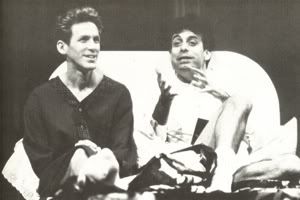
I was thumbing through "Angels in America" for the kazillionith time recently, and began to wax poetically on ethics. “The shaping of the law, not its execution.” Louis ponders the nature of justice in bed beside his lover, Prior. “…it should be the questions and shape of a life…which matters in the end, not some stamp of salvation or damnation which disperses all the complexity in some unsatisfying little decision…”
It’s an interesting supposition to consider. It paints in my mind the image of the tarot card entitled “Judgment”; an angel, eclipsing the horizon, blowing a horn, resurrecting a legion of corpses before the final judgment of Christian tradition; an image that symbolizes this “stamp of salvation or damnation” in a religious life. For the large sect of us who do not subscribe to such an image based on religion, does our secular life hold to similar strictures of judgment? Can our peers judge us in that same way? Can we be damned by society if we do not beg forgiveness for an action? For those of a particular faith, it can be simpler; for others, it cannot.
As the aging Rabbi Chemelwitz points out: “Catholics believe in forgiveness, Jews believe in guilt.” In the Catholic faith, one can commit any transgression he likes, so long as he confesses and repents before his life is over. An entire life composed of immoral, disparaging acts can be rectified in one sitting, thus, the components which make up said life mean little if, before the final judgment is enacted, forgiveness is given. For atheists and agnostics, this is not a scenario in which we can easily place ourselves.
It appears, then, that Louis’s theory is a logical and easily accessible one, especially to people who do not subscribe to a religious faith. Our lives should be judged by the broad spectrum of our actions, by the sum total of what we do and what impression we leave on the world, not one thing we do, whether it be good or bad.
The theory does open up some doors, though, of evasion and disregard towards the transgressions we commit, because to Prior, “…[Louis’s theory] seems to let you off scot-free. …No judgment, no guilt or responsibility.” Does a life of good actions balance out a single misdeed? What if, say, a charity worker commits a murder? If she sacrificed her life helping and aiding hundreds of lives but destroys one, shall she be eternally damned? She can forgive all she wants, but her actions cannot be changed.
Perhaps an amalgam of sorts is in order; perhaps forgiveness is an integral part of an already broad life. Actions cannot be changed, but attitudes can. Perhaps we need to enact the “neo-Hegelian, positivist” sense of the world Louis holds so dearly, confirming that progress, while suffused with pain and struggle, is always for the better. Perhaps we will not get stamped at the end of our lives, but we shall try our hardest to live good ones, no matter how difficult it may be.
[pictured: Joe Mantello and Stephen Spinella, Original Broadway Production]
Sunday, April 5, 2009
The Riddle of Ritalin

Theater Review|"Distracted"
Cynthia Nixon headlines the cast at the Laura Pels Theater and pretty much does all the work on stage, carrying the play on her shoulders and taking the material a little too seriously. Compared to the other actors, at least. The ensemble does a very good job of handling their multiple roles, even if they don't understand the gravity of some of the situations. It is a comedy, after all. But it borders on farce, and seems a little outdated.
Nothing is worse in this world than being "so five minutes ago", and ADHD is in that time frame. Maybe Autism would have been a more appropriate disease to write about. (Of course, as we learn, ADHD is in the Autism spectrum.) Nevertheless the play reads as something from 2006 that was just found in the unpublished archives and dusted off for the Roundabout. For God's sake, there's a tired Bush joke jammed in there. Still, the play is entertaining when not acting like a de facto PSA. There are some funny moments, and some that make you sit and ponder for a spell.
However upon seeing the humble ending to this play, you're left a bit unfulfilled on the subject matter. Or, maybe you're not. I wasn't really paying attention.
DISTRACTED
By Lisa Loomer; directed by Mark Brokaw; sets by Mark Wendland; costumes by Michael Krass; lighting by Jane Cox; original music and sound by David Van Tieghem; projection and video design by Tal Yarden; associate artistic director, Scott Ellis. Presented by the Roundabout Theater Company, Todd Haimes, artistic director. At the Laura Pels Theater, 111 West 46th Street, Manhattan; (212) 719-1300. Through May 10. Running time: 1 hour 45 minutes.
WITH: Peter Benson (Dr. Daniel Broder/Allergist/Dr. Jinks/Dr. Karnes), Shana Dowdeswell (Natalie), Lisa Emery (Vera), Natalie Gold (Dr. Zavala/Waitress/Carolyn/Nurse), Matthew Gumley (Jesse), Mimi Lieber (Sherry), Aleta Mitchell (Dr. Waller/Mrs. Holly/Delivery Person/Nurse), Cynthia Nixon (Mama) and Josh Stamberg (Dad).
Subscribe to:
Posts (Atom)