Tuesday, May 19, 2009

Do I?

Let me tell you a story: a girl of 27 living life humbly as an elementary school teacher meets a fantastic guy and gets engaged. In two months, they will be newlyweds. She will continue to work, she says, but hopes her husband will make enough money so that she can be a stay-at-home housewife. She seems happy enough, and has truly found a man who seamlessly fits into her family; he's cute, smart, and Italian. And no it's not me, just to avoid any misinterpretation of the story. At this point, it does seem as if they will live happily ever after.

Let me tell you another story: a girl of 29, newly hired as a professor at a New York college, soon to complete her dissertation and receive a PhD. She has already completed her Master's, and apparently has nowhere to go but up. Her students love her, she's an excellent teacher, and she has the potential to go on to bigger and better colleges, where one will no doubt grant her tenure. She seems happy enough, and has found, in my mind, a truly satisfying career. In addition to this fabulous success, she also has a domestic partner. No, she isn't a lesbian. Her boyfriend has lived with her so long that the government has ostensibly married them on their tax forms. When asked if she ever wanted to get married, she replied "Eh."

So what do these two stories tell us? One woman happily satisfied with her husband, not with her career, and another woman feeling the exact opposite. So here's the dreadful question we as a society must ask: Who's happier? 

For a long time now, as most people know, the prospect of marriage and family has never appealed to me, and I have for the most part lived for myself. My ambitions are to buy a Classic Six on the Upper East Side, not to share it with someone. I don't mean to pump out another Carrie Bradshaw-esque post on this sorry little blog, but it comes across my mind as strange that I've never once wanted to meet someone, build a life with him and have children. Perhaps because of my orientation, or my disdain for some of my relatives, I have no impulse to propagate my gene pool. Or perhaps it's because I detest little children and would, if given the opportunity, reject rearing them properly and perform psychological experiments on them just out of sheer curiosity. Such as, oh, let's say showering one with gifts and praise and locking the other up in the basement feeding him cow hooves and old milk and comparing and contrasting the final outcome. Or naming my son "Wendy" and force him to wear girls' clothes to see if it has any effect on his gender identification or sexual orientation. 

As it can be seen, Social Services would be up my ass if I were a parent. At least if I were a parent now, anyway. This doesn't really cover the eternal, lifelong relationship part of the equation that I do not enjoy anymore. Why don't I have the urge to shack up with a guy and share my deepest darkest secrets with him? My friends have boyfriends, my cousins have husbands, so what's wrong with me? Perhaps I should just give a relationship a try. And I mean a real relationship, not the two dates and a blowjob in a public restroom kind of relationship that I---have heard some people have. Maybe. 

So what are we to believe? The woman who might not have the best personal life, despite all of the success she has otherwise, is not really happy? If I concentrate on my studies and just try to get degree after degree, what, I'm not worthy of anyone's reverence because I didn't just go to some bar, pick up some guy, and marry him? And what if, maybe, I will really feel fulfillment in my life if I'm in a relationship? What am I to do?   

Anyway, with the prospect of New York legislature granting gay marriage rights to the masses, maybe I should just consider finding a sugar daddy to marry me, that way I can figure this stuff (re: my life) out while not breaking a sweat about my credit card debt or rent bills in exchange for the occasional handjob. That's the kind of relationship I can picture myself in. For the time being, anyway.                 

Friday, May 8, 2009

There's no Business like Show Business.

The official end to the awards season was last Thursday, and the Tony nominations are out. The Seagull was horribly overlooked, and for some reason Rock of Ages racked up a bunch of nominations (including Constantine Maroulis nabbing one for acting). Billy Elliot unsurprisingly garnered the most nominations, not only because it's an adorable little story with great production values, but also because it's the only good musical that opened up this year that seems to be steering Broadway more towards "Vegas", a detraction that producers seem to like because it means higher ticket sales. Nevertheless, I give my regards to the three "Billys": Trent, the sweet one I sorta know, the token ethnic one, and the bitchy one. They all got one nomination for Lead Actor, and honestly that tickles me. Like, they're each one third of an actual person. And, well, let's face it, that's being a little generous with children in regards to their humanity. Anyway, continuing, Waiting for Godot and Mary Stuart were recognized, both getting the Best Revival nod, and so on and so forth. Exit the King got little recognition, sadly, and cult favorites like [title of show] were overlooked, but who really cares? The New York Times pointed out that among the nominees were mostly shows that are still running; which, of course, now being honored with these nominations, means that they can continue to run a little longer due to the press they are getting. And, so, the glaring light of commerce can be shone upon the Great White Way. 

Ruined, a fabulous Off-Broadway play by Lynn Nottage, (which I unfortunately missed an opportunity at seeing but have boned up on by reading everything about it) is not among the nominees of the Tony Awards, despite winning the Pulitzer Prize for Drama. That seems a little strange, no? Well, it's not. The Tony Awards have long been discriminatory, and, in recent years, it has made less and less sense. As of now, with fabulous productions not only Off and Off-off Broadway, but nation-wide, it's perplexing that the Tony Awards, arguably the highest honor in the Theater, still remains limited to about 40 productions. Although, now, it's not hard to see that its prestige is washing away, and the awards seem less like accolades praising great artistic achievements and more like the producers patting themselves on their backs for making a lot of money this season. When did the Tonys become the Grammys?         

It's just a shame a show is discriminated against merely because of its location/producers, and it’s irritating how much credit they get in this industry. Not to devalue them, because certainly no show would exist without good producers, but all they really contribute is money. Of course, this being America, Theater is a business, so a profit is all that matters in the end. Sure, its a double-edged sword, a great show that accumulates no revenue is unsustainable, and a horrible show that's a cash cow can run for years. Nevertheless, Theater is still a very elitist field, and instead of it getting either all fussy and pretentious or mediocre with a universal appeal, they should just take the stick out of their asses and celebrate talented playwrights who want to enlighten as well as entertain; it shouldn't be about the money or drawing in "different crowds" or what have you. And it certainly shouldn't be about glorifying the producers more than the creative team and actors, because that's what we're watching, not checks being signed.  

Tuesday, May 5, 2009

Raining Queen.

Theater Review|'Mary Stuart'

During this inclement week of downpours and cloud-strewn skies, I found myself depressed. Not because of the weather, no, but because I was missing out on it. I have always loved the rain, the refreshing tranquility that comes from feeling beads of water massage my entire body. For a long time I thought this was odd, the fact that I have never owned an umbrella, until I saw the incredible revival of “Mary Stuart” at the Broadhurst Theatre, which opened April 19.  

The titular character of Schiller’s classic, played by Janet McTeer reprising her role in the London Production, celebrates her freedom from prison in a spectacularly simulated rainstorm on stage, dancing and acting like a child after a wrongful imprisonment by her cousin, Queen Elizabeth I. The play is a constant battle between the two Queens, despite them only meeting once (but what a meeting!). While that little anomaly never did happen in real life, the rest is accurate; Mary, Queen of Scots, being the last legitimate child of King James V, sees herself as the rightful Queen of England, as Elizabeth was the daughter of King Henry VIII and Ann Boleyn, which, of course, means she’s a bastard. In the eyes of the Catholic Church, anyway. England, however, is a Protestant country now, with the Pope being viewed as their mortal enemy. I seem to have much in common with Elizabeth as well.

That’s wherein the drama lies. Two Queens bound by blood and rank, share as many similarities as differences. The cold, rational, selfish Elizabeth, deftly portrayed by Harriet Walter, serves the perfect complement to Mary, the earthy, downtrodden Queen supported in England only by a band of rebels. Among these rebels is Mortimer, played by Chandler Williams, whose infatuation with Mary Stuart leads to hysterics and destruction. Bouncing back and forth between the struggles of the two women (and in fact the men) the play examines not only political struggle, but personal struggles as well.  

The production is seemingly flawless and entertaining, with a spectacularly sparse set design by Anthony Ward and highly emotional lighting and sound. The rich costumes of the two women, also by Mr. Ward, certainly do not disappoint in any way. And the clever dressing of the men in more contemporary garments adds intelligence to a production that can easily be classified as a “costume drama”. It’s the mark of a good designer that every choice has a narrative thought and meaning behind it, not just an aesthetic one. These spectacles, while certainly enhancing to the play, are merely the cherry atop the sundae; it would have been just as rewarding to see the two Queens duke it out with only their acting skills.

It is the now iconic scene that opens up the second act that makes this production of Mary Stuart; two highly concentrated personalities finally have a confrontation, one that brings more ruin than the torrential storm. There are few words that are good enough to describe the emotion felt by the audience, and none that can describe the interaction between the two Queens. It is simply something that needs to be watched. 

MARY STUART

By Friedrich Schiller; new version by Peter Oswald; directed by Phyllida Lloyd; sets and costumes by Anthony Ward; lighting by Hugh Vanstone; sound by Paul Arditti; technical supervisors, Aurora Productions. A Donmar Warehouse production, presented by Arielle Tepper Madover, Debra Black, Neal Street Productions/Matthew Byam Shaw, Scott Delman, Barbara Whitman, Jean Doumanian/Ruth Hendel, David Binder/CarlWend Productions/Spring Sirkin, Daryl Roth/James L. Nederlander/Chase Mishkin. At the Broadhurst Theater, 235 West 44th Street, Manhattan; (212) 239-6200. Through Aug. 16. Running time: 2 hours 30 minutes.

WITH: Janet McTeer (Mary Stuart), Harriet Walter (Elizabeth), Tony Carlin (Courtier/Officer), Michael Countryman (Sir Amias Paulet), Adam Greer (O’Kelly/Courtier/Officer), John Benjamin Hickey (Earl of Leicester), Guy Paul (Courtier/Officer), Michael Rudko (Count Aubespine/Melvil), Robert Stanton (Sir William Davison), Maria Tucci (Hanna Kennedy), Chandler Williams (Mortimer), Nicholas Woodeson (Lord Burleigh) and Brian Murray (Earl of Shrewsbury).

Sunday, April 26, 2009

He Never Arrives, BTW.

Theater Review|'Waiting for Godot'

The revolutionary Beckett play, considered a key piece in dramatic literature, is as interesting as it is evasive. Wrapped in repetition and monotony, the Roundabout Theatre’s new production now playing at Studio 54 makes one leave the theatre with more questions to be answered than might be expected. And isn’t that the point of Theater?

It’s been 50 years since the play was produced on Broadway. For a play of such eminence and popularity, it’s dizzying to believe that alarming fact. However, after seeing it, I have an inkling as to why it’s been ignored by producers and actors alike on the Great White Way: it just doesn’t fit into New York sensibility. Or, for that matter, American sensibility. It was originally written in French by an Irish playwright, after all. That must be responsible for some kind of culture shock, especially to Americans. The play is an existentialist’s dream, a sort of nonexistent, purposeless drama that uncomfortably forces one to consider the meaning of life. It does this in the run-around of the superficially meaningless dialogue ranging from theological debate to suicidal desperation, all done in an attempt to counteract the unbearable and inevitable silence that plagues the characters.

This kind of slow, melodic drama is almost unidentifiable to a modern audience. Nothing is spoon-fed, and it’s quite easy to dismiss the material as, dare I say, Seinfeldian absurdity. Probably an unfortunate side effect of being a member of Generation Y, it’s hard to get into the play if one is not willing to do so. Truthfully, the three people I saw it with were appalled, tired and regretful that they wasted their evening—not to mention money—on such a play. I’ll admit my mind wandered a few times, but nevertheless my head is still reeling from the content. 

Nathan Lane leads the play as Estragon, the culinarily named quasi-protagonist, spending most of the play receding into the background in physical exhaustion and misanthropic ambivalence. For the character, it’s expected; for Mr. Lane, it’s not. “Typecasting” is usually comparable to career-suicide in the acting world, but the action of such is not without sense. We expect Mr. Lane to be brash, energetic and hilarious, and Estragon himself is not. As a result, Mr. Lane understandably struggles a bit, doing his best with the more serious material, but obviously over-performing his trademark sense of humor in the small bits of slapstick and one-liners the text offers. He is only half of the main character, though, as I absorbed it. Together with Bill Irwin’s self-evident and heartbreaking Vladimir, the two create a couple contemplating their actions, as well as their own lives, as they wait for a gentleman by the name of Mr. Godot. He never arrives, by the way.

In a world spearheaded currently by twittering and a general sense of impatience at the prospect of anything taking more than two seconds to arrive on our iPhones, this kind of unresolved conclusion may make one want to throw a tantrum right there on 54th street. I’m sure many would have wanted to, but their sense of decorum from societal pressure impeded these actions.

When Pozzo (John Goodman) enters the scene, led in the antediluvian manner of his servant Lucky (John Glover) on a rope, we are hoping for Godot. And by Godot, I mean the action of the play. Perhaps this jolly, domineering man will bring about some conflict. He does, in a way, with Mr. Goodman at least contributing some physicality to the play, most definitely a result of his immense size and presence. But it is Lucky’s logorrheic monologue, rife with biblical, societal and even scatological references, which hurls one of the play’s most intriguing moments. When we sit back and try to soak up every bit of cryptic or ludicrous speech, we are left moved.   

It is at times hard to concentrate on the play, though. An ominous, Bergmanesque set, akin to the cinematography of “The Seventh Seal” might have been a little more fitting for the material, as opposed to the steep claustrophobic Disneyesque cove in which they now ponder. At the heart of the play is the cyclical pointlessness of life, but this existentialist theory is quite literally overshadowed by plastic trees, plaster rocks and a “sky” that is so clear it looks like a movie screen. I wonder why. Maybe because it is. There, I saved you any interpretation. Jane Greenwood’s costumes were typical of the production (Beckett envisioned only one thing about his characters: they would be wearing bowlers), although Mr. Goodman’s jodhpurs were most intriguing, perhaps because they are without a doubt the largest pair I have ever seen.

There is no end to this play; only the inevitable timidity and diffidence associated with life and its choices. We are left waiting, but know that nothing will ever arrive; we must set out to find it ourselves.

WAITING FOR GODOT

By Samuel Beckett; directed by Anthony Page; sets by Santo Loquasto; costumes by Jane Greenwood; lighting by Peter Kaczorowski; Presented by the Roundabout Theater Company, Todd Haimes, artistic director. At the Studio 54 Theatre, 254 West 54th Street, Manhattan; (212) 719-1300; Through July 5th. Running time: 2 hours 15 minutes.

WITH: Nathan Lane (Estragon), Bill Irwin (Vladimir), John Goodman (Pozzo), John Glover (Lucky), Cameron Clifford (Boy), Matthew Schechter (Boy).      

Thursday, April 23, 2009

The Intelligent Blogger's Guide to Theatre and Criticism with a Key to Kushner.


The Guthrie Theater in Minneapolis, Minnesota is currently having a Tony Kushner celebration. In addition to staging his musical, Caroline, or Change, and a collection of short plays (playfully titled "tiny Kushner"), the theater is premiering his latest play, The Intelligent Homosexual's Guide to Capitalism and  Socialism with a Key to the Scriptures, directed by Michael Greif (of Rent and Grey Gardens fame, who also did a fabulous production of Romeo & Juliet two summers ago in Central Park and is currently working on next to normal.)  

With its title derived from George Bernard Shaw's (slightly pedantic) how-to book on economics for women, the play apparently deals directly with gay issues. And, as of today, that's all we get. An intriguing mouthful of a title and a vague description of the subject matter. 

In any event, the play (not to mention its poster) has caught my interest and, while I cannot afford to go to Minnesota at the moment (and, yes, I'd go to even Minnesota for a Kushner play) I can only hope that the production is good enough to be moved to New York, as I am dying to see it. I also would hope that the original cast stays intact because it features two Kushner veterans, Stephen Spinella and Kathleen Chalfant, who both starred in the Original Broadway production of Angels in America back in 1993.    

Honestly, why Minnesota? Kushner said that he wanted to escape the pressure of opening a play in New York, but he needn't be so neurotic; I'm sure it's a fabulous play and I hope to get an opportunity to see it.

Thursday, April 9, 2009

How to Shape the Law

I was thumbing through "Angels in America" for the kazillionith time recently, and began to wax poetically on ethics. “The shaping of the law, not its execution.” Louis ponders the nature of justice in bed beside his lover, Prior. “…it should be the questions and shape of a life…which matters in the end, not some stamp of salvation or damnation which disperses all the complexity in some unsatisfying little decision…”

It’s an interesting supposition to consider.  It paints in my mind the image of the tarot card entitled “Judgment”; an angel, eclipsing the horizon, blowing a horn, resurrecting a legion of corpses before the final judgment of Christian tradition; an image that symbolizes this “stamp of salvation or damnation” in a religious life.  For the large sect of us who do not subscribe to such an image based on religion, does our secular life hold to similar strictures of judgment? Can our peers judge us in that same way? Can we be damned by society if we do not beg forgiveness for an action? For those of a particular faith, it can be simpler; for others, it cannot.

As the aging Rabbi Chemelwitz points out: “Catholics believe in forgiveness, Jews believe in guilt.” In the Catholic faith, one can commit any transgression he likes, so long as he confesses and repents before his life is over. An entire life composed of immoral, disparaging acts can be rectified in one sitting, thus, the components which make up said life mean little if, before the final judgment is enacted, forgiveness is given. For atheists and agnostics, this is not a scenario in which we can easily place ourselves.

            It appears, then, that Louis’s theory is a logical and easily accessible one, especially to people who do not subscribe to a religious faith. Our lives should be judged by the broad spectrum of our actions, by the sum total of what we do and what impression we leave on the world, not one thing we do, whether it be good or bad.

The theory does open up some doors, though, of evasion and disregard towards the transgressions we commit, because to Prior, “…[Louis’s theory] seems to let you off scot-free. …No judgment, no guilt or responsibility.” Does a life of good actions balance out a single misdeed? What if, say, a charity worker commits a murder? If she sacrificed her life helping and aiding hundreds of lives but destroys one, shall she be eternally damned? She can forgive all she wants, but her actions cannot be changed. 

Perhaps an amalgam of sorts is in order; perhaps forgiveness is an integral part of an already broad life. Actions cannot be changed, but attitudes can. Perhaps we need to enact the “neo-Hegelian, positivist” sense of the world Louis holds so dearly, confirming that progress, while suffused with pain and struggle, is always for the better. Perhaps we will not get stamped at the end of our lives, but we shall try our hardest to live good ones, no matter how difficult it may be.     

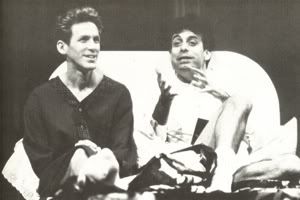
[pictured: Joe Mantello and Stephen Spinella, Original Broadway Production]


Sunday, April 5, 2009

The Riddle of Ritalin


Theater Review|"Distracted"

Never has a play been more aptly named than the new Roundabout Theatre production "Distracted". Because it is. Distracted. From content to production value, this play doesn't know where to start. Amid the dizzying sets, muddled dialogue delivered like bullets to the audience, and the already stale themes of Lisa Loomer's new play about the disorder du jour, this production is nothing but an educational editorial. 

Cynthia Nixon headlines the cast at the Laura Pels Theater and pretty much does all the work on stage, carrying the play on her shoulders and taking the material a little too seriously. Compared to the other actors, at least. The ensemble does a very good job of handling their multiple roles, even if they don't understand the gravity of some of the situations. It is a comedy, after all. But it borders on farce, and seems a little outdated. 

Nothing is worse in this world than being "so five minutes ago", and ADHD is in that time frame. Maybe Autism would have been a more appropriate disease to write about. (Of course, as we learn, ADHD is in the Autism spectrum.) Nevertheless the play reads as something from 2006 that was just found in the unpublished archives and dusted off for the Roundabout. For God's sake, there's a tired Bush joke jammed in there. Still, the play is entertaining when not acting like a de facto PSA. There are some funny moments, and some that make you sit and ponder for a spell. 

However upon seeing the humble ending to this play, you're left a bit unfulfilled on the subject matter. Or, maybe you're not. I wasn't really paying attention. 

DISTRACTED

By Lisa Loomer; directed by Mark Brokaw; sets by Mark Wendland; costumes by Michael Krass; lighting by Jane Cox; original music and sound by David Van Tieghem; projection and video design by Tal Yarden; associate artistic director, Scott Ellis. Presented by the Roundabout Theater Company, Todd Haimes, artistic director. At the Laura Pels Theater, 111 West 46th Street, Manhattan; (212) 719-1300. Through May 10. Running time: 1 hour 45 minutes.

WITH: Peter Benson (Dr. Daniel Broder/Allergist/Dr. Jinks/Dr. Karnes), Shana Dowdeswell (Natalie), Lisa Emery (Vera), Natalie Gold (Dr. Zavala/Waitress/Carolyn/Nurse), Matthew Gumley (Jesse), Mimi Lieber (Sherry), Aleta Mitchell (Dr. Waller/Mrs. Holly/Delivery Person/Nurse), Cynthia Nixon (Mama) and Josh Stamberg (Dad).